Write it.
Start with whatever is in your head. Rough, emotional, incomplete—get it down without trying to sound official.
Before you post
What you say in your Universal Credit journal matters.
Sometimes you know exactly what happened, but you just don't know how to explain it.
That's where UC Journal Companion steps in.
Then let the Companion help.
It works through your situation with you, helps identify what matters, spots things that could be misunderstood, and helps turn it into a much better journal entry before you decide what to copy into your Universal Credit journal.
Less stressed. Better worded. Harder to dismiss.
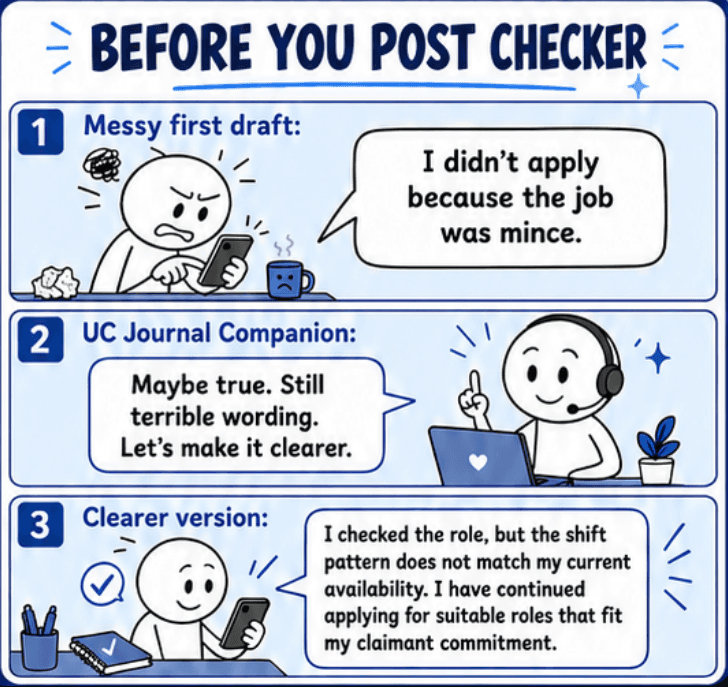
We've all been there
It probably was.
But you can't post that.
Sometimes what you're trying to say and what actually ends up in your journal are two completely different things.
For more people than you think
And that has nothing to do with how real your situation is.
Maybe the thoughts are clear in your head but fall apart when you type them. Maybe you include every detail except the one that matters. Maybe you're already panicking before you open the journal.
UC Journal Companion isn't judging your explanation. It's helping you communicate it properly.
This is the difference
A generic AI can polish the same sentence. The Companion understands Universal Credit situations and works on the explanation behind the words.
Where it matters, it can use the claimant commitments you've chosen to save alongside official Universal Credit guidance held within the app. That helps it prepare a clearer, stronger and more complete version of your explanation—without inventing facts or speaking over you.
Like somebody reading what you've written and quietly saying…
“Hang on.”
“You've missed the important bit.”
“Explain why that happened.”
“Actually… this is what you need to say.”
A note from the founder
UC journal messages are written at exactly the wrong moment—when you're stressed, worried or trying to explain too much at once.
I built UC Journal Companion to give you a calm place to work through what happened before adding it to your official journal. I wish something like this had existed when I needed it.
It's here to help you explain your side clearly—not to judge you or speak over you, but to help you write the strongest version of what you need to say.
Why it matters
89.9%
of adverse Universal Credit sanction decisions in the latest reported year were for failure to attend or participate in a mandatory interview.
DWP statistics to May 2026Missed appointments and claimant commitments matter because they can affect your payment. An appointment time is easy to record. What happened around it—illness, childcare, access problems, confusion, an emergency—can be much harder to explain when you're under pressure.
The Companion cannot decide the outcome. It can help you prepare the strongest factual explanation possible, based on what actually happened.
Universal Credit guides
Choose the guide that matches what you need help with. Each is designed to help you understand the official position or organise clearer journal wording before you post.
No complicated process
Start with whatever is in your head. Rough, emotional, incomplete—get it down without trying to sound official.
The Companion helps find the real point, asks for what's missing and spots wording that could be misunderstood.
Check every word. Change anything you want. Then copy the finished version into your journal yourself.
A calmer way to write
Try the complete Companion free for 3 days. After that, it's £5 a month—just over £1 a week for a clearer head before you post.
Card required. Cancel before the trial ends to avoid being charged.